Decolonise Your Mind
Why Peace Lotus day is important and lessons from the 2023 Decolonial International Symposium
On this significant date of April 30th, we mark the end of the Vietnam War in 1975. Today, 49 years ago, saw the departure of US troops from Saigon, now Ho Chi Minh City. In Vietnam, it is a public holiday called Reunification Day.
Peace Lotus Day honours not only the indigenous struggle against colonial violence, imperialism and genocide, but also the ecocide wrought by warfare. It serves as a call to reflect on war around us today, learn from communities and cultures of resistance in the face of legacies and realities of continued colonialism, and foster an intersectional, international, and intergenerational approach to our resistance.
At RJN, we see the interconnectedness of struggles and expansion of imperialism and colonisation through continued apartheid, genocide, occupation of land, violence, silencing. Although war is shown as being far away, close to home are the impacts of having to grapple with the lack of safety, dignity, and the pain, grief and anguish that comes with being blatantly dehumanised – through the direct experiences of violence and harms. The ancestral and intergenerational traumas we carry from being subject to colonial exploits around the world, and the resistance movements of Black, Brown, Indigenous communities around the world have lessons for us. They show us that another world is possible.
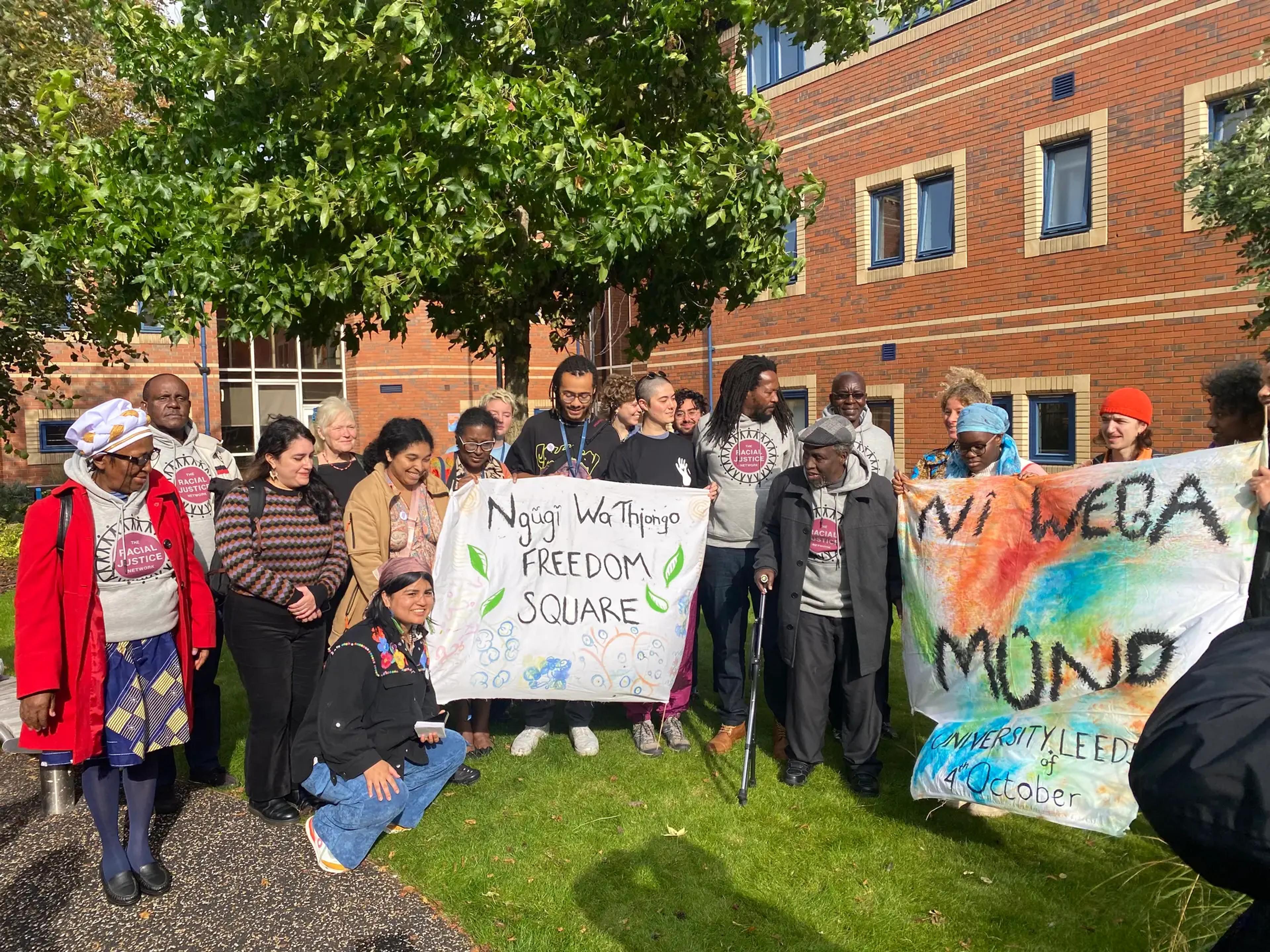
In October 2023, we hosted a Decolonial International Symposium bringing scholars and activists from Kenya, alongside our special guest, Elder and Professor Ngũgĩ wa Thiong’o. He reminded us that we are still experiencing the impacts of western domination, or as he called it normalised abnormalities. The imbalances are undeniable and have created a world where not all voices, languages, people are appreciated for the knowledge that they embody and carry. It is our job to pave the way for that to change; his legacy and time with us have many lessons for us to take and build on.
Read about the highlights from the 2023 Decolonial International Symposium
We are so excited to launch a documentary showcasing all the learning alongside Ngũgĩ wa Thiong’o last year. It highlights his time with us, and shows us the importance of deep international, intergenerational, intersection analysis and experiences.
Building on the Decolonial International Symposium, we are honoured to welcome back Elder and Professor Ngũgĩ wa Thiong’o, along with Esther Xosei, Peninah Wangari-J, and Ndungi Githuku to reflect on the significance of Peace Lotus Day and its relevance in today’s world, exploring resistance in the face of continued imperialist and colonialist oppression.
Join our webinar on Wednesday, 1 May 2024 at 18:00 – 20:30 BST
Links to wider movements
Peace Lotus Day is one of the three key annual dates of internationalist solidarity glocalization commemorations of the Extinction Rebellion Internationalist Solidarity Network (XRISN) and the Majority World Internationalist Solidarity Coordination Council of Communities of Resistance (MWISCCCOR). The coming together was spearheaded by organisations and movements in South and Southeast Asia and West Africa. This is facilitated by the Extinction Rebellion Affinity Network of Asia (XRANA) and supported by XRISN and highlighted by Planet Repairs Action Learning Educational Revolution (PRALER). The connecting thread of internationalist solidarity is the resistance of imperialism and colonialism, including ecocide and genocide.
Environmental destruction and imperialism have always gone hand in hand. The violence on a mass scale that war brings has devastating impacts on both humans and the earth. Justice and peace is also about earth care. The machinery of war is intertwined with exploitation of Mother Earth’s ecosystems and equilibrium. Our work on climate justice, encapsulated in the 13th recommendation `highlights that justice and peace is also about earth care.
Read the 13th Recommendation Report
Related Articles
RJN Statement on the Transitioning of Professor Jason Arday
24/08/2026 • RJN Team
One Year After Dr Pious Nyandoro: The Uncomfortable Truth About Empire, Borders and the Value of Black Life
23/07/2026 • Boucka Koffi